
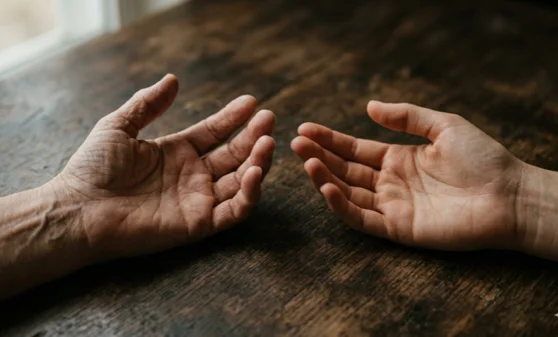
It often begins quietly.
A shoulder that no longer opens with ease. A joint that stiffens in the cold. A subtle heaviness that lingers beneath the surface of the body.
At first, it is easy to ignore — to stretch, to push through, to keep moving. But over time, the discomfort becomes more persistent, less predictable, and increasingly difficult to resolve.
From a biomedical perspective, these patterns are often classified as inflammation or degenerative conditions. In Classical Chinese Medicine, they are understood differently — and more precisely.
They are recognized as Bi Syndrome (痹): a state of obstruction.
When Function Becomes Obstructed
In Chinese Medicine, health depends on the smooth, unimpeded flow of Qi (functional energy) and Blood through the body's channels. When that flow is blocked, pain, stiffness, and restriction arise.
The character Bi (痹) denotes impediment — a condition in which movement through the channels is hindered.
According to classical texts such as the Huang Di Nei Jing (Su Wen, Bi Lun chapter), this obstruction occurs when external pathogenic factors — Wind, Cold, and Dampness — invade the body and lodge in the muscles, joints, and channels:
When Wind, Cold, and Damp converge, they give rise to Bi.
What begins as an external invasion may, over time, become an internalized pattern — particularly when the body's Zheng-Wei Qi (upright-defensive Qi) is no longer sufficient to resist or expel it.
How Bi Manifests: Differentiating Patterns
Bi Syndrome is not a single condition. It is understood through pattern differentiation, where the nature of the pain reflects the nature of the obstruction.
Three primary patterns arise according to the predominance of Wind, Cold, or Dampness. A fourth reflects the transformation of these factors into Heat over time.
Wind Bi (行痹 — Wandering Obstruction): pain that shifts location — elusive, variable, unpredictable. Wind disrupts stability within the channels.
Cold Bi (痛痹 — Painful Obstruction): sharp, constricting pain that contracts and slows circulation. Characteristically improves with warmth.
Damp Bi (着痹 — Fixed Obstruction): heaviness, numbness, and a persistent sense of burden in the limbs. Dampness obstructs and lingers, impeding clear movement.
Heat Bi (热痹 — Transformative Stage): a later evolution, where prolonged obstruction generates heat. Inflammation, redness, and burning sensations emerge — often alongside underlying Qi and Blood vacuity.
Beyond the Joints: Where Bi Takes Hold
Although Bi Syndrome is most commonly associated with the joints, classical texts describe its manifestation across different tissues and organ systems — reflecting a broader, deeper pattern of obstruction.
What begins at the surface does not always remain there. Obstruction may localize in the Flesh (muscle tissue) — presenting as tension, fatigue, or heaviness; in the Sinews (tendons) — leading to stiffness and restricted mobility; in the Bones — associated with chronic weakness or structural decline; and in the Channels and vessels — impairing the flow of Qi and Blood.
In more advanced stages, Bi may also involve the internal organ systems (Zang-Fu) — including the Heart-Pericardium, Liver-Gallbladder, Spleen-Pancreas-Stomach, Lung-Large Intestine, and Kidney-Bladder — reflecting a systemic level of obstruction that extends well beyond musculoskeletal pain.
Classical texts also describe additional manifestations, including Blood Bi, Joint-Running Wind (li jie feng), and more generalized forms of obstruction.
From Diagnosis to Treatment: A Pattern-Based Approach
From a biomedical perspective, conditions such as arthritis, sciatica, or spondylosis are treated as distinct diagnoses. In Chinese Medicine, they are understood through their underlying patterns — and treated through pattern differentiation (bian zheng).
Acupuncture Strategy
Treatment is not standardized — it is tailored to the pattern. Guided by the nature of the obstruction and its location within the channels, treatment combines pattern-based point selection, local points at the site of pain, and points along the affected channel.
These are often reinforced by Ashi points (阿是穴) — tender, reactive points that indicate areas of local stagnation.
Practical guide to acupoint selection by affected area:
Shoulder — Primary: LI-15 (Jianyu), TB-14 (Jianliao), SI-10 (Naoshu). Support: LI-4, TB-5, SI-3.
Elbow — Primary: LI-11 (Quchi), LU-5 (Chize), TB-10 (Tianjing). Support: LI-4, TB-5.
Wrist — Primary: TB-4 (Yangchi), TB-5 (Waiguan), LI-5 (Yangxi), SI-4 (Wangu).
Spine — Primary: GV-26 (Shuigou), GV-12 (Shenzhu), GV-4 (Mingmen), GV-3 (Yaoyangguan).
Hip / Thigh — Primary: GB-30 (Huantiao), GB-29 (Juliao), GB-39 (Xuanzhong). Support: GB-34, BL-40.
Knee — Primary: Xiyan (Eye of the Knee), ST-34 (Liangqiu). Support: GB-34, SP-9, GB-33.
Ankle — Primary: BL-62 (Shenmai), KI-6 (Zhaohai), BL-60 (Kunlun). Support: GB-40, ST-41.
Returning to Function
Bi Syndrome is not only about pain. It reflects a disruption in the flow of Qi and Blood — affecting movement, circulation, and the body's capacity to adapt and self-regulate.
As obstruction is resolved, something begins to shift. Circulation returns. Movement softens. The body gradually reorganizes itself.
Like ice melting, or water finding its course again — flow is restored not by force, but by allowing what has been blocked to open.
Recovery is not imposed. It emerges.
Through appropriate pattern differentiation and treatment, obstruction can be cleared and circulation restored — supporting the body's inherent capacity for regulation, recovery, and functional balance.