There is a pattern that presents with remarkable consistency across very different kinds of patients: the athlete who trains with discipline but wakes exhausted. The executive who has been functioning at high output for years and suddenly cannot recover between demands. The professional who describes a fatigue that sleep no longer resolves, accompanied by a vague sense that the body is consuming something it cannot replenish.
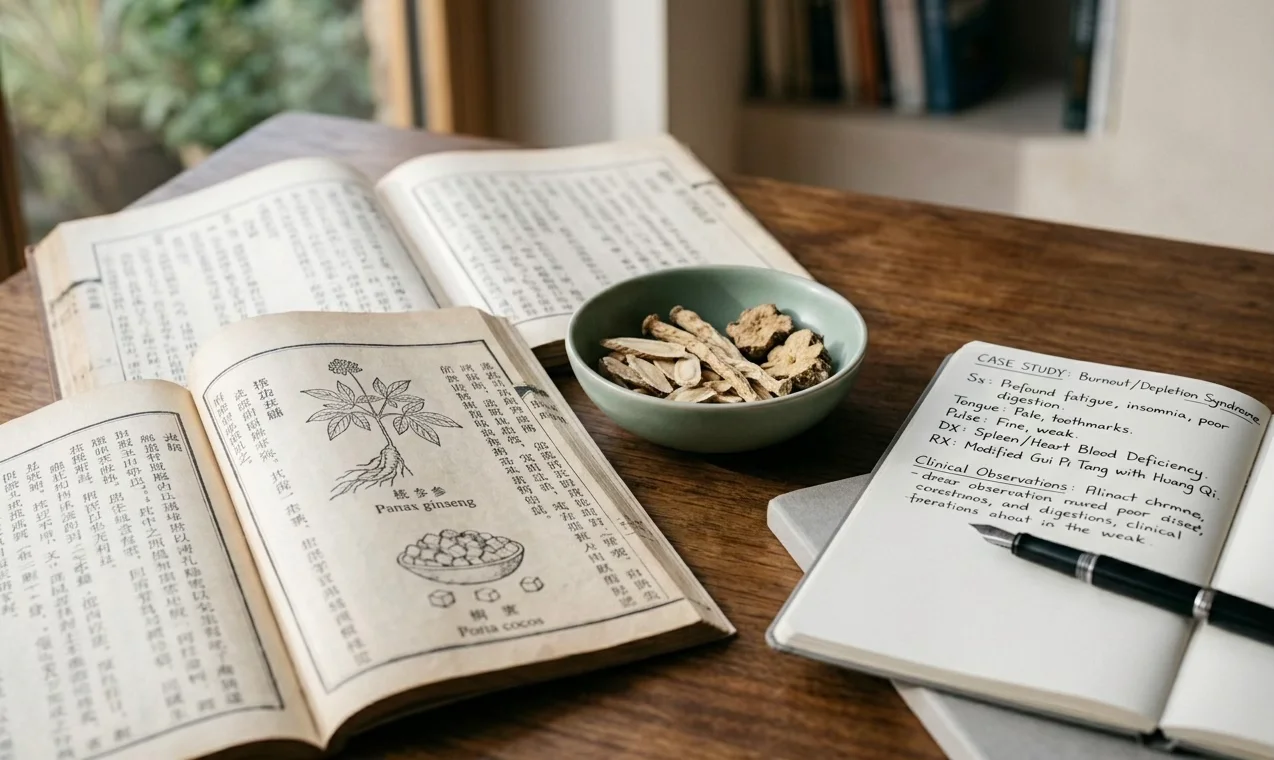
In Chinese medicine, this pattern has been documented, classified, and treated for over two millennia. It is called Xu Lao (虚劳) — most accurately translated as Consumption Syndrome or Deficiency Taxation — and it represents one of the most clinically significant and systematically underdiagnosed conditions in high-demand populations today.
What Is Xu Lao (虚劳)?
Xu Lao is not an acute condition. It does not arrive suddenly. It is the result of a prolonged process in which the body's fundamental reserves — its Zheng Qi (正气), or upright functional capacity — are drawn down faster than they can be restored.
Classical Chinese medicine understands the body as a system of continuous circulation and transformation. Qi (气) moves. Blood (血) nourishes. Yin (阴) cools and anchors. Yang (阳) warms and activates. Health is not the absence of symptoms — it is the unobstructed, balanced movement of these substances through their proper pathways, in their correct proportions, at the right temperature.
When sustained demand — physical, cognitive, or emotional — exceeds the body's regenerative capacity over time, this balance is progressively lost. The substances decline in a predictable sequence. The circulation becomes insufficient. The thermal regulation breaks down. The body, unable to meet demand from its functional reserves, begins drawing from its structural ones.
The organism stops running on its current production and starts consuming its own architecture.
Two Languages, One Biological Reality
One of the most productive developments in contemporary integrative medicine has been the systematic cross-referencing of Chinese medicine frameworks with biomedical physiology. In the case of Xu Lao, the correspondence is particularly precise:
Depletion of Zheng Qi (正气) maps to a measurable decrease in endogenous antioxidants such as glutathione.
Qi (气) deficiency corresponds to deep metabolic fatigue and a mitochondrial ATP deficit.
Yang (阳) deficiency reflects hormonal and metabolic hypofunction.
Yin (阴) deficiency presents as chronic inflammation, night sweating, and impaired thermal regulation.
What Chinese medicine identified through centuries of clinical observation as patterns of depletion, modern medicine now maps through laboratory markers. The frameworks are different. The biological reality they describe is the same.
The Warning Signals the Body Sends Before It Collapses
Xu Lao does not arrive without warning. The body communicates its depletion through a recognizable cluster of signals that, read individually, are easy to dismiss — and read together, constitute a clear clinical pattern in Chinese medicine.
Night sweating: waking drenched despite normal room temperature. In Chinese medicine, this indicates Yin (阴) failing to anchor Yang (阳) during the night. The body's cooling and containment capacity is losing ground.
Impaired thermoregulation: the paradox of cold extremities alongside heat sensations in the face or chest. Persistent thirst that hydration alone does not resolve. This is not a deficit of warmth — it is a failure of Yang (阳) to circulate and distribute properly.
Persistent insomnia with profound fatigue: not difficulty falling asleep from overstimulation, but the specific and paradoxical pattern of extreme exhaustion coexisting with an inability to reach restorative sleep. In Chinese medicine, this is a hallmark of Shen (神) disturbance.
Wandering musculoskeletal pain: lumbar heaviness, joint discomfort, or muscle aching without clear structural cause. This pattern points to Liver Blood (肝血) insufficiency failing to nourish and moisten the tendons and sinews. When Blood does not reach the tissues, they communicate through pain.
Recurrent viral reactivation: frequent cold sores or recurrent infections signal that Wei Qi (卫气) — the body's defensive surface energy — has been compromised. The interior depletion has reached the body's outermost layer of protection.
Clinical Protocols: Treating the Root, Not the Branch
Treatment of Xu Lao in Chinese medicine is organized according to the specific nature and depth of the depletion. The governing principle is consistent: address the Ben (本), the root, not merely the Biao (标), the branch manifestation.
Protocol 1 — Tonifying Qi (气) and Yang (阳). Indicated for lumbar weakness, cold sensitivity, difficulty sustaining effort, low functional warmth, and metabolic fatigue. This pattern reflects depletion at the level of Kidney-Yang (肾阳) — the body's deepest source of warmth and functional drive. Key points: ST36 (足三里), CV4 (关元), BL23 (肾俞). Formula: Huang Qi Jian Zhong Tang (黄芪建中汤).
Protocol 2 — Nourishing Yin (阴) and Regulating Fluids. Indicated for night sweating, internal heat sensations, persistent thirst, restless sleep, and anxiety within a context of deep fatigue. Yin (阴) deficiency represents the depletion of the body's cooling, moistening, and anchoring substances. When Yin is insufficient, Yang (阳) becomes uncontained — generating characteristic heat signs in the context of profound underlying exhaustion. Key points: KI6 (照海), KI3 (太溪), SP6 (三阴交). Formula: Mu Li San (牡蛎散).
Protocol 3 — Restoring Jing (精), Tissue Integrity, and Shen (神). Indicated for muscle wasting, significant cognitive decline, emotional flatness, loss of drive that does not respond to rest, and profound disconnection from self. This is the deepest pattern of Xu Lao — depletion at the level of the Jing (精), the constitutional essence stored in the Kidneys. Jing is the body's deepest reserve. When the system has been drawing from it over an extended period, the depletion becomes visible not only in function but in structure. Key points: BL43 (膏肓俞), GV4 (命门). Formula: Gui Pi Tang (归脾汤).
The Principle of Preservation
High performance — athletic, professional, or otherwise — is sustainable only when output is matched by genuine restoration. Chinese medicine does not view ambition or sustained effort as pathological. It views the absence of a recovery architecture as the structural error that makes Xu Lao inevitable.
The body always signals its depletion before it collapses. The clinical value of the Chinese medicine framework is precisely its capacity to read those signals early — through the quality of circulation, the state of thermal regulation, the condition of the Shen — before the depletion has reached the structural level where recovery becomes measured in months rather than weeks.
Xu Lao is not weakness. It is a call from the body to return to functional balance.
A Note on Integration
What Chinese medicine reads through the lens of circulation, temperature, and systemic pattern — the quality of Yang's warmth, the sufficiency of Yin's anchorage, the integrity of the Wei Qi at the surface — other clinical disciplines approach through their own frameworks and instruments. The functional medicine assessment will map the same patient's hormonal and inflammatory picture. The clinical nutrition evaluation will identify the dietary patterns that are preventing the Yin from being rebuilt and the Blood from being replenished.
From the Chinese medicine perspective, these are not competing readings. They are complementary views of the same patient — each adding resolution to the clinical picture that the others cannot fully see alone. When all three perspectives inform the treatment simultaneously, the recovery is more complete because no layer of the depletion is left unaddressed.
At Alquimia, Xu Lao and its clinical equivalents are approached as what they are: a multisystem depletion requiring the simultaneous perspective of Chinese medicine, functional medicine, and clinical nutrition. The integration is not theoretical. It is the clinical structure through which recovery becomes complete.